ElevenLabs Alternatives in 2026: Options That Are Actually Better


ElevenLabs built its reputation on studio-grade voice synthesis, and for single-language English voiceovers, it remains a strong product. But the credit-based pricing model, the 70-language ceiling, and the absence of production-grade video dubbing have pushed a growing number of creators and media teams toward platforms that cover more of the localization pipeline in one place.
The alternatives worth considering in 2026 are not clones of ElevenLabs with different branding. Each one solves a different problem. Some prioritize cost efficiency. Others prioritize dubbing depth or real-time deployment. The question is not which platform has the best marketing page. The question is which platform matches what you actually need to ship.
TL;DR: Which ElevenLabs Alternative Fits Your Use Case?
Quick decision guide before the full breakdown:
- Need to dub existing video into 150+ languages while preserving the speaker's original voice? Switch to CAMB.AI.
- Need affordable voiceovers for podcasts or presentations with studio-quality polish? Evaluate Murf AI or PlayHT.
- Need real-time voice for AI agents and conversational interfaces? Look at Cartesia or Deepgram.
- Need text-based audio editing where you fix spoken mistakes by editing a transcript? Descript is the only real option.
Before we begin, I wanted to go over why video content creators might consider switching from ElevenLabs in the first place. ⤵️
Quick Comparison Table
Why are content creators looking to switch from ElevenLabs?
Customers are looking to switch from ElevenLabs because they’re seeking better voice accuracy, advanced customization (like emotion tuning and multiple voice retention), and fairer pricing that doesn’t rapidly deplete credits for minor edits.
We’re not saying that ElevenLabs is a bad solution; in fact, hundreds of happy users are satisfied with the tool’s ease of use for generating sound effects and various voices for narrations.
The software does a good job of helping content creators bring a professional polish to everything, from patient education scripts to marketing videos, with human-sounding content.

However, some users of the platform have been dissatisfied with the AI voice solution for several reasons:
Occasional voice quality & accuracy issues
Verified users of the tool claim that the voice quality can deteriorate in longer passages, and there are occasional glitches reported, such as unexpected noises, voice inconsistencies, or unnatural transitions.
According to a small business owner, when they try to create a voice inside of ElevenLabs, it is hardly ever accurate.
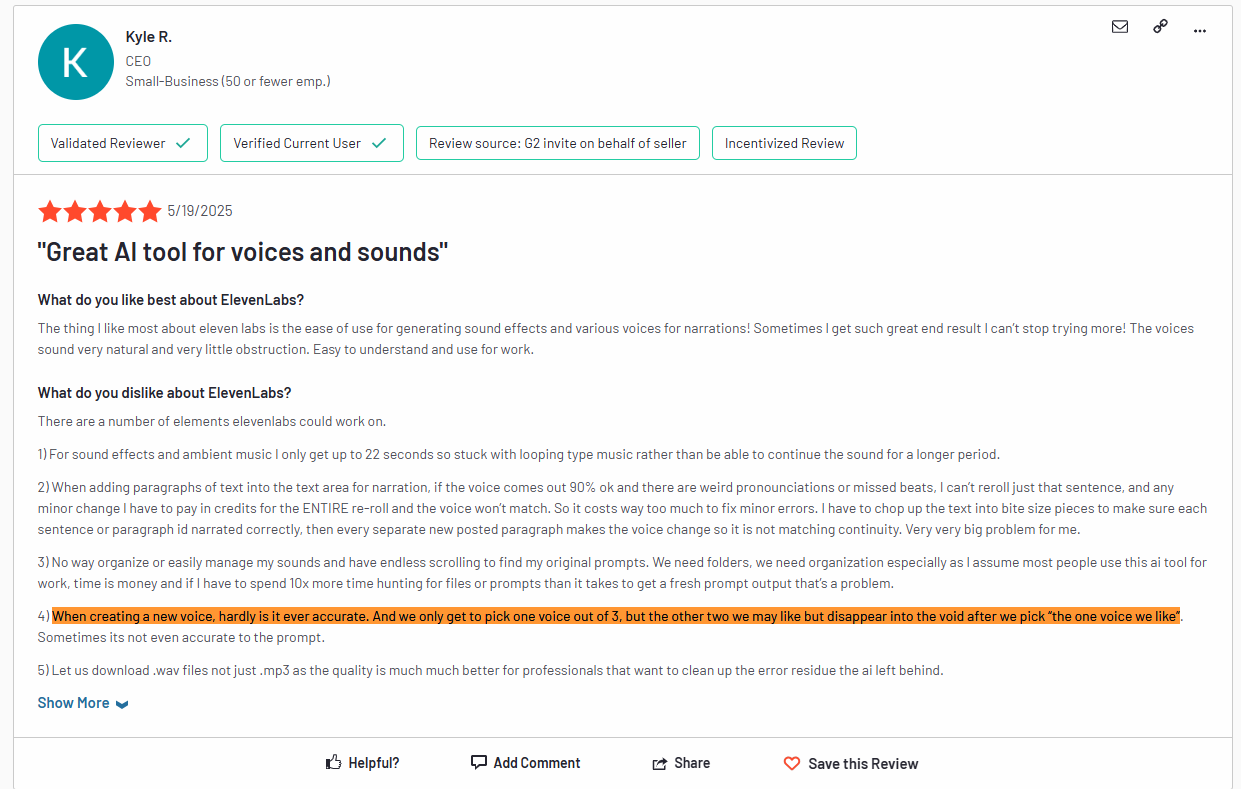
‘’When creating a new voice, it is hardly ever accurate. And we only get to pick one voice out of 3, but the other two we may like but disappear into the void after we pick “the one voice we like.’’ – G2 Review.
Limitations of certain features and customization options
The platform seems to offer limited options for custom voice creation and selection, with some users unable to retain multiple generated voices for later use.
According to G2 reviews, some features, such as fine-tuning your pitch, tonality, and emotional nuance after cloning your voice, are constrained, while features like advanced style transfer are lacking altogether.

‘‘Limited custom control over voice pitch/tone post-cloning without re-recording inputs. It also lacks advanced voice style transfer or emotion fine-tuning features.'' – G2 Review.
Credit Consumption on Small Edits
ElevenLabs charges credits for every re-render, even when the change is a single word. A paragraph-level fix consumes the same credits as generating the full passage from scratch. For teams iterating on scripts, this burns through monthly allocations faster than expected.

‘’The fact that any small change means it needs to re-render an entire section of audio, eating up many credits. If I want to change one word, one letter, I should be charged by changing that one word, a sentence at most, but not an entire paragraph or section.’’ – G2 Review.
Language Ceiling at 70+
Seventy languages cover the most common commercial markets, but teams localizing into Southeast Asian, African, or less-resourced language pairs hit the ceiling quickly. Platforms like CAMB.AI (150+) and PlayHT (140+) offer significantly broader coverage without requiring a supplementary translation tool.
No Full Video Dubbing Pipeline
ElevenLabs generates audio. Turning that audio into a dubbed video with lip sync, timing alignment, and background audio preservation requires stitching together additional tools. For teams whose end product is a localized video rather than an audio file, a dedicated dubbing platform eliminates that integration work.
The Alternatives, Ranked by Use Case
Each platform below is evaluated on voice quality, language coverage, pricing model, and workflow fit. The ranking reflects production readiness for the stated use case, not a universal best-to-worst order.
CAMB.AI: The Switch for Video Dubbing and Multilingual Localization
CAMB.AI is not a voice generator that competes with ElevenLabs on the same feature set. The platform runs a full localization pipeline: transcription, neural translation (BOLI model), voice cloning (MARS8 model family), lip synchronization, and subtitle generation in a single workflow through DubStudio.
The MARS8 model achieves 0.87 WavLM speaker similarity on the MAMBA benchmark, preserving the original speaker's vocal identity across languages with measurably higher fidelity than generic TTS outputs. Speaker diarization identifies individual speakers automatically, so a multi-presenter video gets distinct voice profiles without manual tagging.
For live content, DubStream converts a single broadcast feed into multilingual streams in real time. Partners including NASCAR, Ligue 1, and the Australian Open use this infrastructure for live sports coverage across language markets.
Where ElevenLabs generates audio files, CAMB.AI delivers finished localized video. For teams whose workflow ends with a dubbed MP4 rather than a WAV file, the comparison is not close.
Pricing: GPU-based model. Free 30-day trial with full feature access. Enterprise pricing available.
PlayHT: Large Voice Library at Competitive Pricing
PlayHT offers 600+ AI voices across 140+ languages with voice cloning available on paid plans. The platform focuses on audio generation rather than video dubbing, making it a closer feature-for-feature competitor to ElevenLabs than CAMB.AI.
Voice quality on English and major European languages is strong. The 140+ language count exceeds ElevenLabs by a wide margin. API access is available for developers building voice into applications.
Limitations: No video dubbing, no lip sync, no subtitle generation. PlayHT generates audio, and the surrounding video workflow is the user's responsibility.
Pricing: Starts at $31.20/month (annual billing). Per-character billing applies.
Murf AI: Studio-Grade Voiceovers for Presentations and E-Learning
Murf AI targets teams producing voiceovers for corporate training, product demos, and presentation decks. The built-in editor syncs generated speech with visual content and allows pitch, speed, and emphasis adjustments at the word level.
Voice variety (120+ voices across 20+ languages) covers most corporate use cases. The interface is approachable for non-technical users, and batch processing handles multiple scripts efficiently.
Limitations: 20+ languages is far below platforms built for global localization. Some voices sound noticeably synthetic on longer passages. No video dubbing capability.
Pricing: Free trial. Paid plans from $19/month.
Speechify: Best for Reading and Accessibility, Not Production
Speechify converts text, PDFs, and web pages into spoken audio. The platform is built for consumption (listening to articles, books, and documents) rather than content production.
100+ voices across 30+ languages cover personal use well. Cross-platform support (browser, desktop, mobile) makes Speechify the strongest option for users who want to listen to written content rather than produce voiced media.
Limitations: No voice cloning. No API. No video dubbing. Speechify is a reading tool, not a production tool. Comparing it to ElevenLabs is only valid if your use case is listening to text rather than generating voices for content.
Pricing: Free tier. Premium from $29/month.
Descript: Text-Based Editing with Overdub
Descript's value proposition is unique: edit audio and video by editing a transcript. The Overdub feature generates speech in a cloned voice, allowing users to fix spoken mistakes without re-recording. For podcast producers and video editors, the transcript-as-timeline workflow eliminates the need for traditional audio editing skills.
Limitations: Limited language support. Voice cloning quality trails dedicated TTS platforms. Descript is an editing tool that includes voice generation, not a voice platform that includes editing.
Pricing: From $16/month (annual billing).
Making the Switch
Moving from ElevenLabs to another platform does not require rebuilding workflows from scratch. Most alternatives offer API endpoints compatible with common integration patterns, and voice cloning on any platform starts with the same input: a short audio sample of the target voice.
For teams currently using ElevenLabs for audio generation but assembling dubbed videos manually, switching to a platform with a full dubbing pipeline consolidates what is currently a multi-tool workflow into a single interface. The time savings compound with every language added.
The right alternative depends on where your workflow ends. If the deliverable is an audio file, PlayHT and Murf are credible options at lower cost. If the deliverable is a localized video with the original voice preserved across languages, CAMB.AI is the platform built for that outcome.
Try the 30-day free trial on CAMB.AI and compare output quality on your own content before committing to any platform.
Let your users experience your story in every language with Camb AI
Each AI voice generation and dubbing platform that we went through has its strengths and weaknesses.
We discussed the 10 best alternatives to ElevenLabs for AI voice generation that can help you create videos, dub content, and create powerful stories at scale.
Built for content creators, media producers, and global brands who want to translate English for the world, Camb AI offers the world’s most capable speech and translation AI, which will help you dub and translate content into over 140 languages.
If you’re looking for a dubbing solution that provides:
- High-fidelity voice translation & dubbing in 140+ languages, preserving original voice, emotion, and tone.
- Lip-sync accuracy to align mouth movements perfectly with translated speech.
- Minimal-data voice cloning (~5 seconds of audio needed) to replicate unique vocal characteristics across languages.
- Integrated Text-to-Speech & Text Translation to deliver contextually fluent, emotion-aware output in any language.
- Multi-speaker & background handling with speaker diarization, voice isolation, and seamless re-integration of music and effects.
Then you can schedule an Enterprise call to learn more about CAMB.AI or start right away for free.
Egal, ob Sie Medienprofi oder Sprach-KI-Produktentwickler sind, dieser Newsletter ist Ihr Leitfaden für alles, was mit Sprach- und Lokalisierungstechnologie zu tun hat.
Häufig gestellte Fragen
Verwandte Artikel