How to Use Google Lumiere: A Deep Dive Guide


Artificial intelligence continues to reshape the landscape of technology, and Google Lumiere is at the forefront of this revolution. For those curious about how to use Google Lumiere, this article offers an in-depth exploration of this cutting-edge AI tool.
We'll discuss what Lumiere is, how it came about, its applications, and the industries it impacts.
Additionally, we'll discuss how CAMB.AI can enhance Lumiere-generated videos, providing a comprehensive guide on how to use Lumiere Google effectively.
What Is Google Lumiere?
Google Lumiere is an advanced AI model developed by Google's research team, designed to generate realistic and coherent videos from textual descriptions or images. Utilizing a space-time diffusion model known as the Space-Time U-Net (STUNet), Lumiere creates seamless videos that exhibit natural motion and high temporal consistency.
Processing all frames simultaneously sets it apart from traditional video generation methods that often produce disjointed results.
How Did Google Lumiere Come About?
The development of Lumiere stems from Google's ongoing commitment to advancing AI and machine learning technologies.
Building upon previous models like VideoPoet, Google's researchers aimed to overcome limitations in video generation, such as temporal inconsistencies and lack of realism.
Introducing the STUNet architecture allowed them to achieve a model capable of generating videos that align closely with the provided textual or visual inputs. The result represents a significant milestone in AI-driven content creation.
What Is Lumiere Used For?
Lumiere's primary function is to generate videos from text descriptions or images, opening up new possibilities in content creation. Some potential applications include:
- Writers and artists can visualize their ideas by turning scripts or concepts into dynamic videos without traditional filming.
- Brands have the ability to produce tailored video content that resonates with specific audiences, enhancing engagement and conversion rates.
- Educators can create visual aids that simplify complex concepts, making learning more interactive and accessible.
- Filmmakers and game developers can generate scenes or animations, streamlining the production process.
- Creating descriptive videos for visually impaired users improves inclusivity.
How to Use Google LumiereWhile Lumiere is currently in development, here's how the process will work:
- Input Your Vision
Start by entering a detailed text prompt describing your desired video or uploading a reference image. - Specify Details
The STUNet model processes your input, predicting object positions and movements within the video frame. - Generate and Refine
Lumiere creates seamless transitions between frames, producing a cohesive video that matches your specifications. You can then apply style modifications or make regional animations using features like Cinemagraphs.
Note: As of January 28, 2025, Lumiere is not yet available for public use, but is expected to integrate with Google's suite of AI tools in the future.Industries Impacted by Google LumiereThe ripple effect of Lumiere's technology extends across various industries. Below are some sectors that stand to benefit significantly:
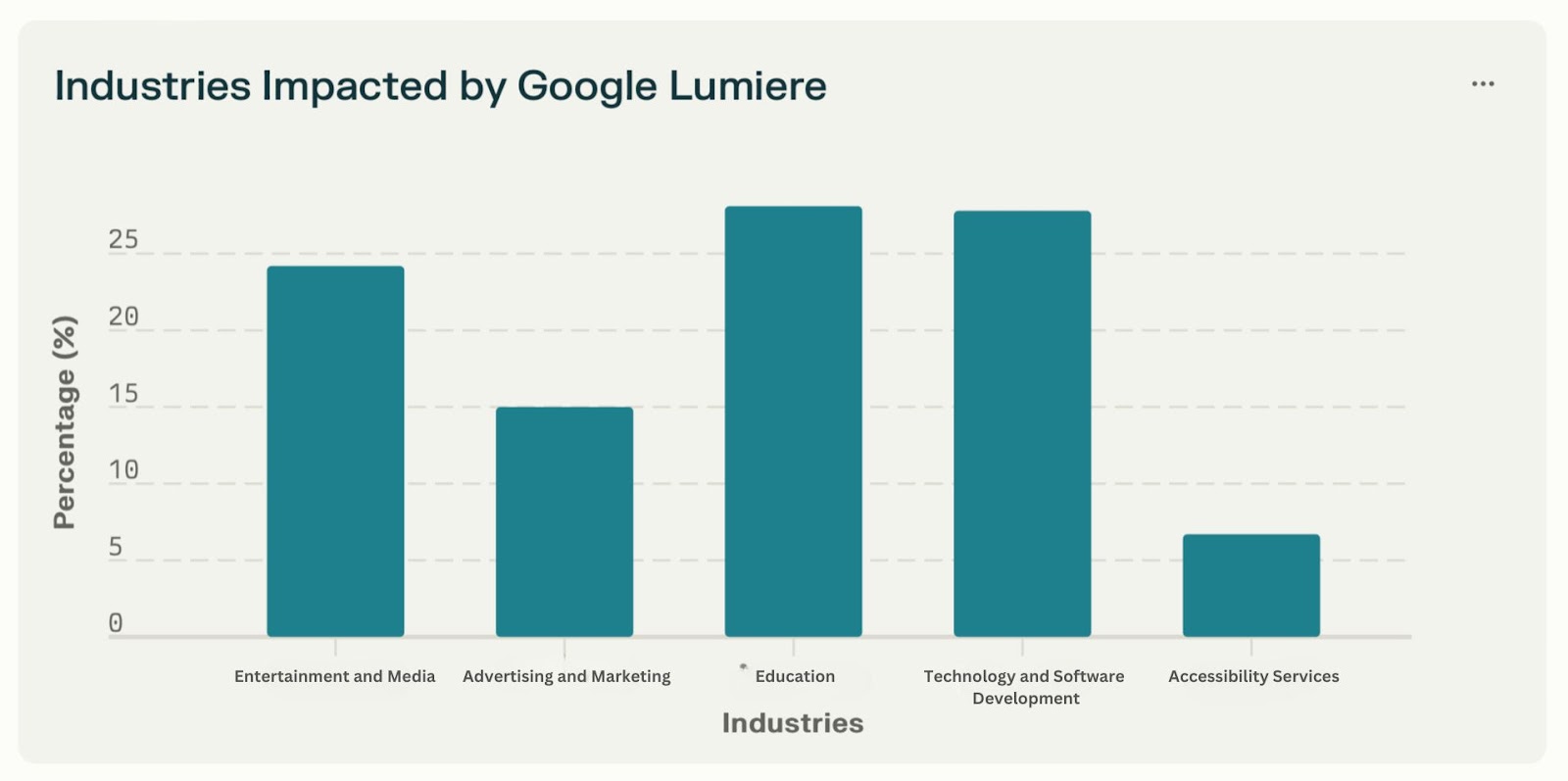
Entertainment and Media
The entertainment industry is experiencing significant AI adoption, with a 24.2% annual growth rate in the AI media market from 2025 to 2030. Lumiere revolutionizes content creation by automating video generation, reducing production costs, and accelerating timelines.Advertising and MarketingIn the marketing sector, AI-driven personalization has shown to increase revenue by 15% through enhanced customer targeting. Lumiere allows marketers to create customized video content at scale, enhancing customer engagement and driving sales.EducationThe generative AI market in media and entertainment is growing at 28.1% annually, impacting educational content creation. Lumiere helps develop interactive educational videos, making complex subjects more digestible for students.Technology and Software DevelopmentThe generative AI market in media and entertainment is projected to reach $6.73 billion by 2029, representing a 27.8% compound annual growth rate. Lumiere offers tools for prototyping and visualizing concepts, aiding in software development and user experience design.Accessibility ServicesThe gaming industry, which includes accessibility features, has seen a 6.7% increase in workforce growth. Lumiere generates videos that assist individuals with disabilities, promoting inclusivity.
Enhancing Lumiere-Generated Videos with CAMB.AI
While Lumiere excels at generating high-quality videos, integrating it with CAMB.AI further enhances the content, especially in terms of audio and language accessibility.
What Is CAMB.AI?
CAMB.AI is an AI-powered platform specializing in speech and translation services. The platform offers a suite of tools designed to complement video content by adding realistic voiceovers, translations, and more.
How CAMB.AI Enhances Lumiere Videos
Here are ways CAMB.AI augments Lumiere-generated videos:
- Converting scripts into natural-sounding voiceovers adds a professional audio layer to your videos. This feature is particularly useful when Lumiere generates silent videos.
- With the ability to translate content into over 140 languages, CAMB.AI helps you reach a global audience. This functionality is invaluable for marketing campaigns and educational materials targeting diverse demographics.
- The MARS AI Model enables voice cloning using just a few seconds of audio. This capability allows for consistent branding or character voices across different videos.
- Dubbing your videos with CAMB.AI synchronizes translated voiceovers with the visual content seamlessly.
- Assisting in creating engaging narratives, the platform's AI enhances the storytelling aspect of your videos.
Steps to Enhance Videos with CAMB.AI
- Generate your video content using Google Lumiere.
- Write or refine your script to ensure it aligns with the visual content.
- Upload your script to CAMB.AI and select the desired voice and language for the voiceover.
- Utilize the MARS AI Model to clone a specific voice if required.
- Sync the generated voiceover with your Lumiere video, adjusting timing as necessary.
- If targeting a multilingual audience, use CAMB.AI's translation and dubbing features to create versions in different languages.
- Review the final product for coherence and quality before publishing or distributing it.
Conclusion
Google Lumiere represents a significant advancement in AI-driven video generation, offering unprecedented opportunities across various industries. Understanding how to use Lumiere Google effectively positions you at the forefront of this technological wave. Integrating Lumiere with tools like CAMB.AI enhances your videos with professional voiceovers, translations, and more, amplifying their impact.
Ready to elevate your content creation process? Sign up for a free trial with CAMB.AI here and unlock the full potential of AI-enhanced video production.
Whether you're a media professional or voice AI product developer, this newsletter is your go-to guide to everything in speech and localization tech.
Frequently Asked Questions
Related Articles